A college town with a commercial strip
Grove City has three distinct property markets and we get called for all of them. There is the older borough housing around the college, a large student and faculty rental market, and the commercial corridor out toward the interstate and the outlets.
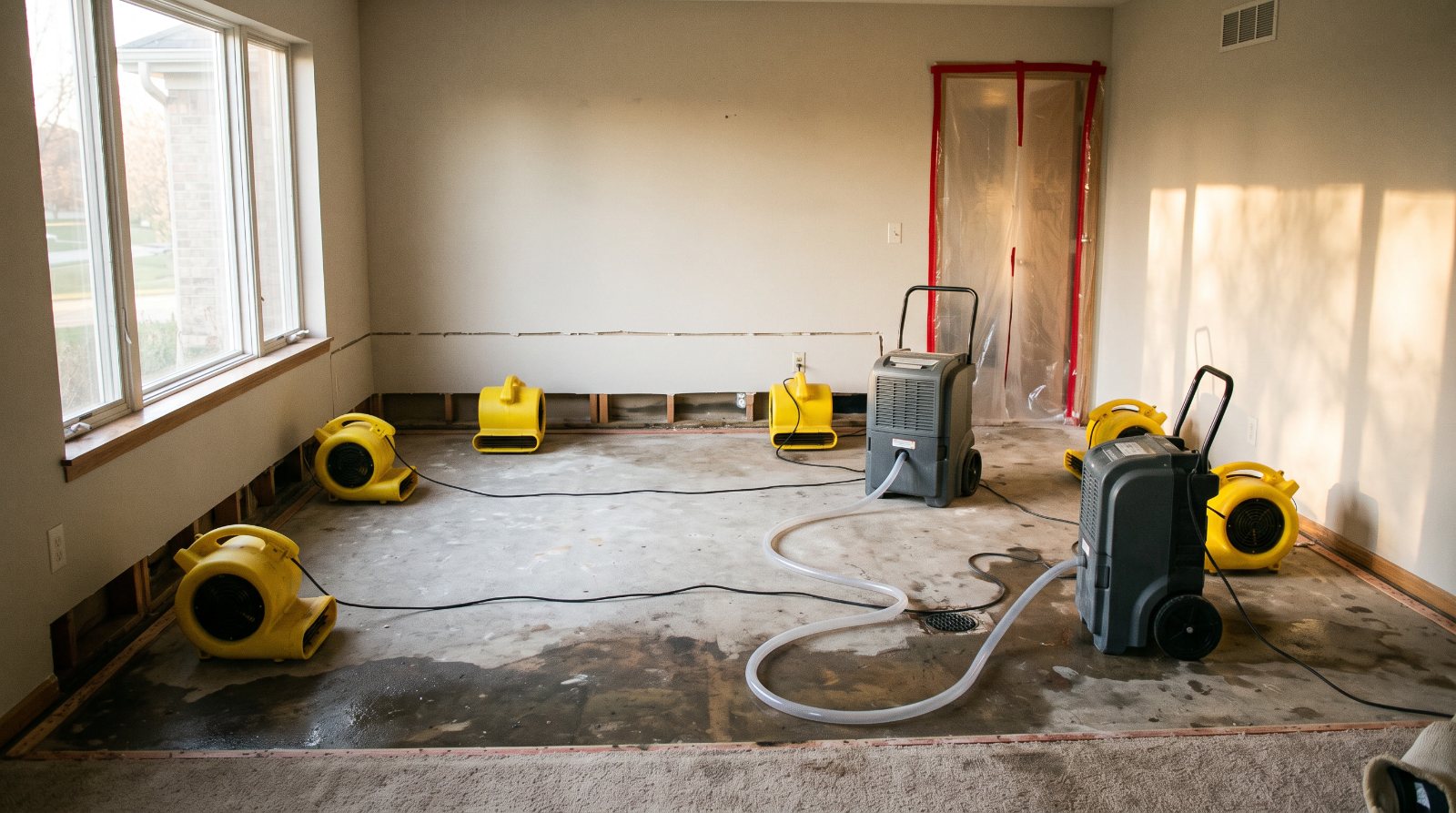
The rental market drives the most calls. Properties sit empty over college breaks, and a supply line that splits in an unoccupied house in January runs until someone comes back. What would have been a straightforward drying job at hour two is mold remediation, demolition and rebuild at day six. Multi-unit conversions add the cascade problem: one failure upstairs puts water through several units, several tenants, and one complicated claim.
The commercial side behaves like Hermitage — retail and hospitality where being closed costs more than the repair, so the work gets phased, contained, and run overnight where possible. The borough housing itself is older frame stock with the usual profile: block foundations, uninsulated supply runs, clay laterals in places, and hard inland freezes.
Grove City runs about two hours from our Erie staging point and is covered 24 hours a day.
Shut the water main off if it's a supply leak. Kill power at the breaker to the affected area if water is near outlets — never wade into standing water to reach the panel. Lift what you can. Photograph everything before it's touched.
Grove City areas we serve
Grove City Borough · Pine Township · Springfield Township · Grove City College area · Broad Street · Main Street · Route 208 corridor · Route 58 corridor · I-79 & outlet corridor · Wolf Creek area
All services in Grove City
Three markets, three problems
Empty rental leaks
A split line in an unoccupied house runs for days. Drying job at hour two, remediation by day six.
Multi-unit cascades
One upper-floor failure through several units and tenants, documented separately per unit for the claim.
Commercial interruption
Retail and hospitality where closure costs more than repair. Contained, phased, worked overnight.
Frozen supply lines
Older borough stock with long uninsulated runs through hard inland freezes.
Grove City questions
How long to reach Grove City?
Roughly two hours from Erie. The dispatcher will give you that straight and start walking you through shutting off and stabilising immediately.
I am a landlord with student tenants. How does this work?
We need authorisation to enter and start mitigation, and whoever holds the policy. We handle tenant notices and access scheduling directly, contain and dry unit by unit so unaffected tenants can usually stay put, and keep documentation separated per unit for the claim and any later deposit question.
The house was empty for two weeks over break. Still worth calling?
Yes, and promptly. At that point microbial growth is likely alongside the water damage, so the scope includes containment and remediation. How long it ran is precisely what a carrier will ask, so proper documentation matters more, not less.
Can you work around our retail hours?
Yes. Containment isolates the affected area so the rest of the space trades, and noisy or disruptive phases run overnight. We will be honest about which areas genuinely have to close.