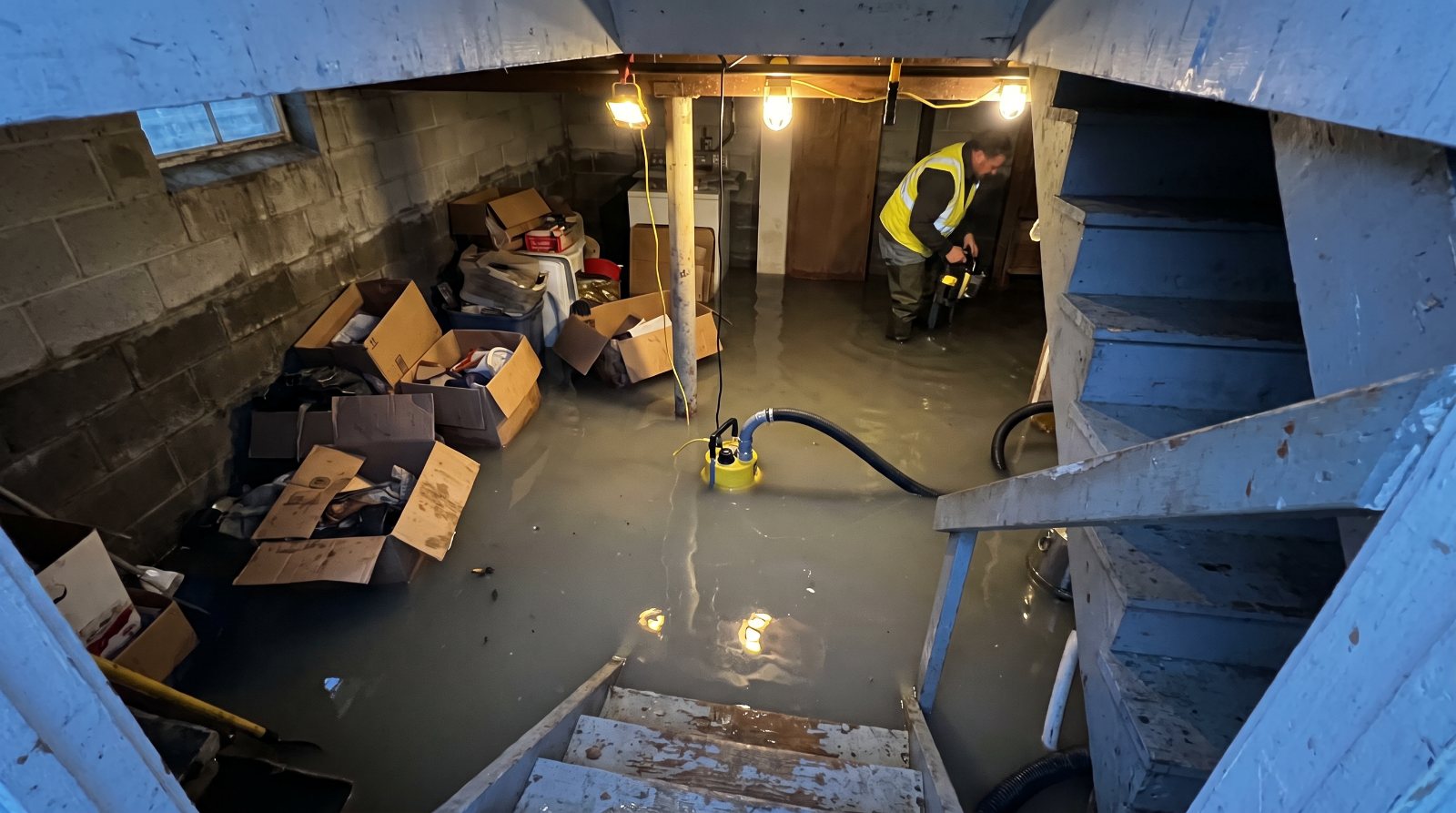
This is the shortest article on this site and probably the most useful one. Go and read your declarations page. If there is no water backup endorsement on it, the single most common basement loss in Erie County is not covered.
What a standard policy does not cover
A standard Pennsylvania homeowners policy covers sudden and accidental water damage from inside the plumbing system — a burst supply line, a failed water heater, an appliance connection letting go. That much people generally know.
What it does not cover, unless you have specifically added it, is water that backs up through a sewer, a drain, or a sump pit. Sewer backup, drain backup, and sump pump failure or overflow all sit outside the base policy and require a separate endorsement, usually called water backup or sump overflow coverage.
Why it matters more here than most places
Two features of Erie County housing make this the loss we respond to most. First, large parts of the older city and the boroughs are still served by aging clay sewer laterals, which crack and take root intrusion, so a heavy rain that would be a non-event elsewhere surcharges back through a floor drain.
Second, the townships — Millcreek, Harborcreek, Fairview, McKean — have an unusually high proportion of finished lower levels. Carpet, pad, drywall, drop ceiling, a family room, sometimes a bedroom. That is the most expensive kind of space to flood, because nearly everything in it is porous and, in a backup, contaminated.
Add the spring thaw putting sump pumps under continuous load during the exact storms that take the power out, and you have the profile of a loss that is both common and, for a lot of households, entirely uninsured.
A water backup endorsement is usually an inexpensive annual add-on relative to the exposure, and limits are commonly available in tiers. Compare that to what a finished basement rebuild costs and the arithmetic is not close. Ask your agent for the endorsement, the limit options, and whether the limit is separate from your dwelling coverage.
Three things to check while you have the page open
If a backup has already happened
Sewage is Category 3 water. Carpet, pad, drywall and insulation it touched cannot be disinfected in place — they come out. The area is contained under HEPA negative air, decontaminated, dried to standard, and then rebuilt. Anyone offering to clean and dry a sewage-affected finished basement without removing porous material is not doing the job properly, and it will smell within a month.
One last honest note: even without the endorsement, call. We will tell you plainly what is likely covered and what is not before you file, and if the repair is close enough to your deductible that filing is not worth it, we will say that too.
Backup in your basement now?
Stay out of the water and call. We will tell you what to shut off and how to keep it contained.