SHIELD RESTORATION · ERIE, PA7 MIN READIICRC CERTIFIED FIRM #70248702
A frozen pipe is not the emergency. The emergency is the thaw, when the split you cannot see starts delivering water at line pressure into a wall.
Why pipes actually burst
Water expands as it freezes, but the pipe rarely fails at the ice. What happens is that an ice plug forms and then keeps growing, and the pressure of the water trapped between that plug and a closed faucet or valve builds until something gives — usually a few feet away from the ice itself, at a fitting or a weak point.
This is why a pipe can freeze on Monday, be discovered frozen on Tuesday, and flood the house on Wednesday afternoon when the sun comes out. The failure is already there; the ice is temporarily plugging its own hole. A half-inch split at household pressure moves a genuinely startling volume of water — several hundred gallons in a few hours is ordinary.
The five runs that go first in this housing stock
01
Exterior wall runsCommon in pre-1960 Erie houses where a kitchen or bathroom was plumbed into an outside wall, often with little or no insulation behind the pipe. The pipe sits between the drywall and the sheathing with the entire winter on the other side.
02
Unheated basement joist baysLong horizontal runs across a basement ceiling, particularly near foundation vents, a window well, or the sill plate. Older Erie basements leak cold air around the sill more than people expect.
03
Crawl spacesThe worst of the lot. An uninsulated crawl with vents open, bare soil, and supply lines running through it is effectively outdoor plumbing. This is where we see the most splits in the townships.
04
Garages and rooms built over themAny supply line into or through an attached garage, plus bonus rooms above garages where the floor cavity is cold. Very common in the newer Millcreek, Fairview and McKean builds.
05
Outside hose bibs and unused fixturesA frost-free sillcock still fails if a hose is left attached over winter, because the hose holds water against the valve. Also seasonal fixtures — a basement laundry sink, an unused bathroom in a closed-off wing — where nothing moves for months.
What to do before December
Insulate the vulnerable runs. Foam pipe sleeve on every accessible supply line in a basement, crawl space, garage, or exterior wall. It is inexpensive, and it is the single highest-return hour you will spend on the house.
Air seal the sill plate. Cold air pouring in around the sill is what makes basement runs freeze. Spray foam or caulk at the rim joist does more than pipe insulation alone.
Deal with the crawl space. Close the vents for winter, get a vapour barrier over bare soil, and insulate the pipe runs. An encapsulated crawl solves several problems at once.
Disconnect every hose. All of them, including the one on the back of the garage you forgot about. Drain and shut off any interior valve feeding an exterior bib.
Insulate the garage supply line, and keep the garage door shut. An open garage door on a ten-degree night is a freeze event for anything plumbed in there.
Find and label the main shut-off. Then have somebody else in the household find it while you watch. At 3am in the dark with water coming through a ceiling is not the moment to learn where it is.
The one-dollar trick that works
On a night forecast to go well below freezing, open the cabinet doors under sinks on exterior walls and let a pencil-thin trickle run from the furthest fixture on the vulnerable run. Moving water is much harder to freeze, and the open faucet relieves the pressure that actually splits the pipe. It costs a few gallons and it prevents the failure mode entirely.
If it is already frozen but has not burst
01
Shut the main off firstBefore you thaw anything. If there is a split you cannot see, thawing it with the main open turns a frozen pipe into a flood.
02
Open the nearest faucetIt gives the melting ice somewhere to go and relieves pressure as the plug releases.
03
Thaw gently, from the faucet end backwardsA hair dryer, a heat gun on low, a space heater aimed at the area, or towels soaked in hot water. Work from the fixture toward the frozen section so meltwater can escape.
04
Never use an open flamePropane torches on frozen pipes cause house fires every winter, and they can flash-boil water inside the pipe and rupture it. Do not.
05
Watch it as it releasesStay there with the main partly open and eyes on the pipe. If water appears anywhere it should not, shut the main immediately.
IF IT HAS ALREADY SPLIT
Shut the main off. Kill power at the breaker to any area where water is near outlets or the panel — but do not wade into standing water to reach it. Move what you can lift. Photograph everything before anything is touched, because that is what your claim is built on. Then call. A burst supply line is generally a covered sudden loss under a standard Pennsylvania policy, and the documentation from the first hour is what keeps it that way.
Empty houses are the real risk
The worst losses we see are not the occupied houses. They are the rentals empty over a college break, the seasonal lake properties, the estate house between owners, and the wing of a big old place nobody uses. A split line in an occupied house is found in minutes. In an empty one it runs for a week, and by the time somebody opens the door the job includes mold remediation, demolition and a difficult conversation with a carrier about how long it was unattended.
If a property will be empty in winter: never set the heat below about 55 degrees, have somebody physically check it every few days, and consider shutting the water off at the main and draining the system if it will be empty for weeks. A cheap freeze alarm or a smart thermostat with a low-temperature alert is worth many times its price.
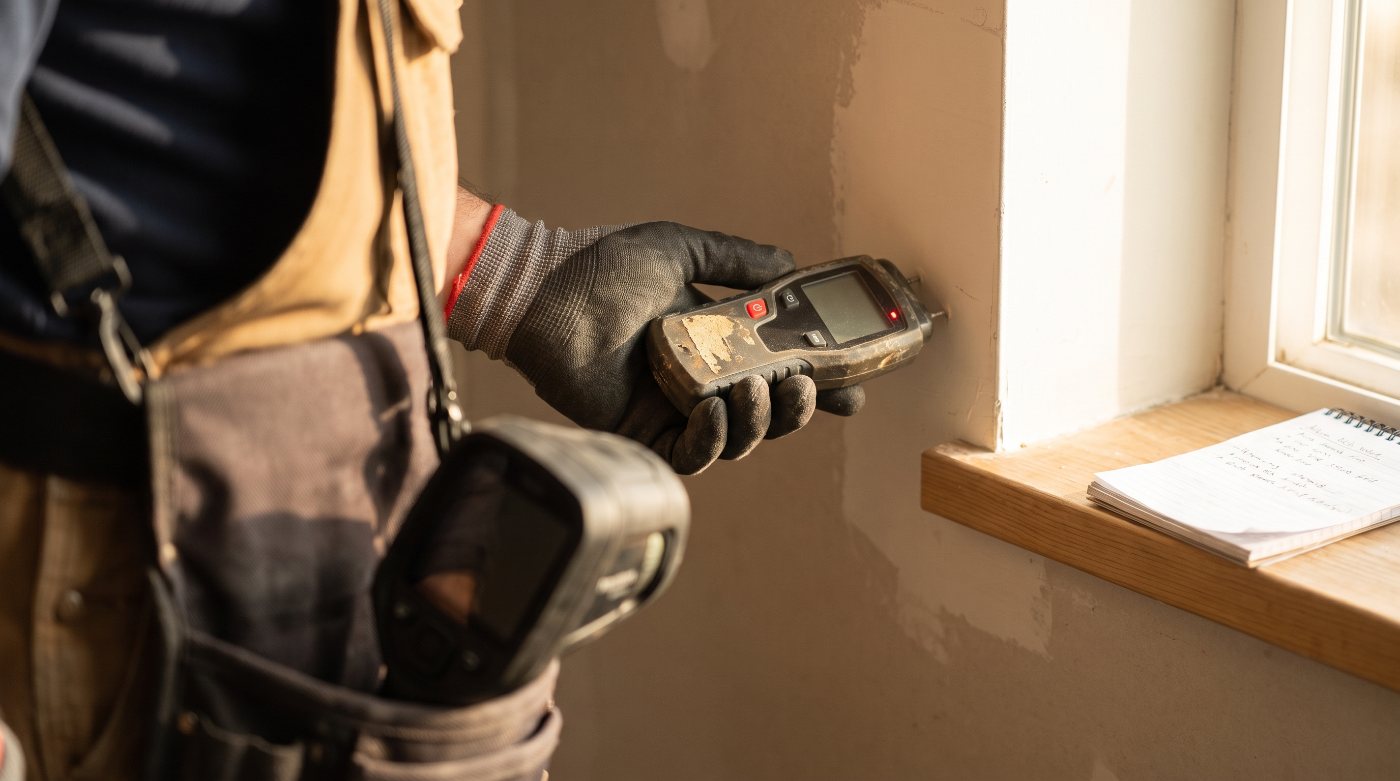
After a split, the wet area inside the wall is what matters — and it is always bigger than the visible damage.
Pipe already split?
Shut the main off, then call. We will talk you through the rest while a crew is en route.